

Introduction
Customer support continues its rapid evolution, and 2025 marks a pivotal year for self-service adoption. What began as a convenience has transformed into a competitive necessity. Organizations that once viewed self-service as a supplementary channel now recognize it as the primary gateway to customer engagement.
This year's survey captured insights from more than 156 professionals across industries, revealing how self-service has solidified its position at the center of customer experience strategy. The data demonstrates that self-service excellence is no longer confined to support teams—it's a company-wide imperative that spans pre-sales engagement through customer retention and growth.
As AI capabilities mature and customer expectations intensify, this report examines how organizations are adapting their self-service strategies to meet the moment. We dive into what's working, where gaps remain, and what separates leaders from followers in delivering exceptional self-service experiences.
This year's survey captured insights from more than 156 professionals across industries, revealing how self-service has solidified its position at the center of customer experience strategy. The data demonstrates that self-service excellence is no longer confined to support teams—it's a company-wide imperative that spans pre-sales engagement through customer retention and growth.
As AI capabilities mature and customer expectations intensify, this report examines how organizations are adapting their self-service strategies to meet the moment. We dive into what's working, where gaps remain, and what separates leaders from followers in delivering exceptional self-service experiences.
Setting the Foundation
Before participating, we offered this definition of self-service to ensure alignment:
Customer self-service is the digital-first approach to customer support where organizations empower users to independently resolve issues and find information online.
Customer self-service is the digital-first approach to customer support where organizations empower users to independently resolve issues and find information online.
Who Participated
This survey captured a diverse cross-section of professionals representing various roles and industries.
By Role
The majority of respondents were individual contributors (33%) and managers at various levels, with team leads at 13%, managers at 17%, and senior managers at 10%. Directors represented another 10% of responses.
The majority of respondents were individual contributors (33%) and managers at various levels, with team leads at 13%, managers at 17%, and senior managers at 10%. Directors represented another 10% of responses.
Graph 1: Survey Respondents by Role

33%
Individual Contributor (IC)

17%
Manager

13%
Team Lead

10%
Senior Manager

10%
Director

5%
Senior Director

5%
Other

4%
C-Suite

3%
Contractor
By Industry
Technology & Software led participation at 51%, followed by Manufacturing at 9%, and Business Services and Telecom at 6%.
Technology & Software led participation at 51%, followed by Manufacturing at 9%, and Business Services and Telecom at 6%.
Graph 2: Industries Represented by Respondents

By Company Size
Organizations of all sizes participated, with strong representation from mid-size companies (51-250 employees at 16% and 251-1,000 employees at 24%), as well as larger enterprises.
By Customer Type
This diverse participation—spanning all organizational levels, industries, company sizes, and customer types—demonstrates that self-service has matured into a universal business imperative, with B2B organizations leading adoption due to the complexity of serving business customers who demand sophisticated self-service capabilities.
Graph 3: Industries Represented by Company Size

Graph 4: Industries Represented by Customer Type
.svg)
CHAPTER ONE
Self-Service as the First Stop
Current State of Implementation
In 2025, 58% of organizations have already implemented self-service solutions, with an additional 22% intending to implement them soon. This represents significant momentum compared to last year, with only 1% remaining firm in their decision not to implement some sort of self-service.
Graph 5: Do you have a self-service solution implemented?

The Data Speaks Clearly
Self-service has cemented its position as customers' preferred first touchpoint. When asked which support channel customers use first, 35% of respondents reported that self-service (knowledge bases and FAQs) tops the list, followed by email support at 31% and phone support at 18%.
This isn't surprising; it's the natural evolution of customer behavior. When faced with a question or issue, customers instinctively turn to search engines and help centers. They expect answers immediately, on their own schedule, without waiting in queue or scheduling a call.
This isn't surprising; it's the natural evolution of customer behavior. When faced with a question or issue, customers instinctively turn to search engines and help centers. They expect answers immediately, on their own schedule, without waiting in queue or scheduling a call.
Graph 6: Which of these support channels is your customer most likely to use first?
.svg)
The Cost of Getting It Wrong
Here's the critical insight: customers want to self-serve, but poor execution drives them away. When self-service content is difficult to find, outdated, or incomplete, customers abandon it for human support channels. This creates a cascade of negative outcomes:
- Increased support costs
- Longer resolution times
- Customer frustration
- Decreased satisfaction scores
- Lost revenue opportunities
Graph 7: Primary Support Challenges
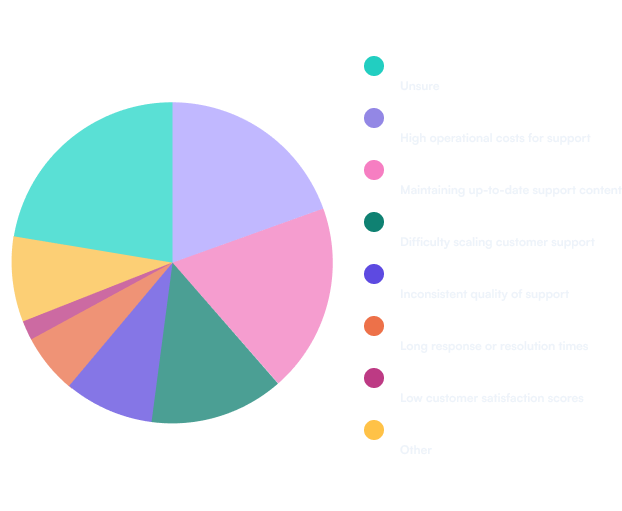
That last point deserves emphasis: poor self-service directly impacts the bottom line. Frustrated customers who can't find answers are more likely to churn, delay renewals, or scale back usage. Prospective buyers encountering inadequate self-service during evaluation may choose competitors instead. When customers can't resolve issues quickly, they experience downtime that erodes the value of your product, as well as their willingness to expand or recommend it.
The organizations succeeding in 2025 understand that self-service isn't just about having a help center—it's about having one that actually works.

CHAPTER TWO
Self-Service Across the Customer Journey
Primary Audiences
Survey respondents identified their primary self-service audiences as:
- External customers: 47%
- Mix of both internal and external users: 37%
- Internal employees: 6%
This data reveals an important evolution: organizations are increasingly recognizing that self-service platforms must serve multiple constituencies. While external customers remain the primary focus, the significant percentage serving mixed audiences (37%) highlights that employees need access to the same knowledge to properly serve customers.
Graph 8: Self-Service End User Audiences
47%
External customers
6%
Internal employees

5%
Developers or technical users
5%
Other
37%
All of the above
The Most Common Issues
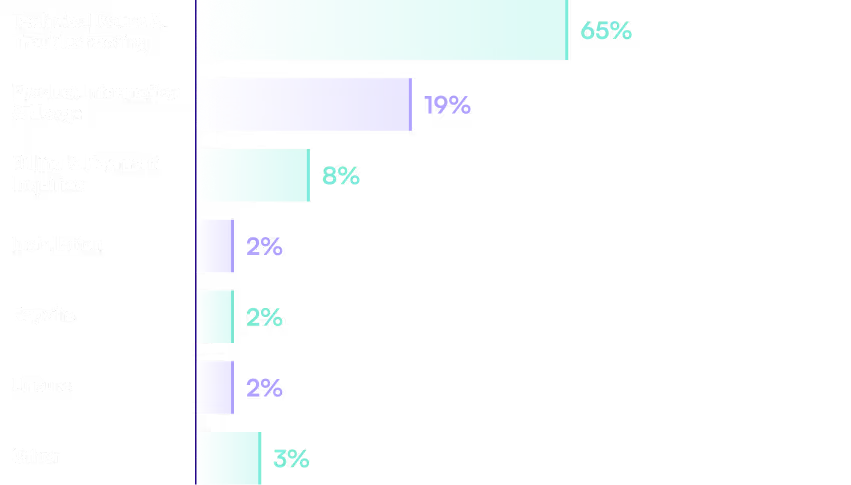
Customer issue types addressed through self-service in 2025:
- Technical issues and troubleshooting: 65%
- Product information and usage: 19%
- Billing and payment inquiries: 8%
Key Insight: Technical issues remain the dominant use case, underscoring the critical importance of comprehensive onboarding documentation and troubleshooting resources. Organizations that excel at self-service invest heavily in clear, accurate technical content that empowers users to resolve complex issues independently.
Graph 9: Customer Issue Types
Beyond Support: A Strategic Asset
The prominence of technical troubleshooting in self-service platforms isn't just a support issue—it's a product and engineering issue. When customers can successfully resolve technical problems on their own, it signals:
- Clear, well-designed product functionality
- Quality documentation integrated into the development process
- Reduced friction in the customer experience
- Lower total cost of ownership for customers
Organizations that treat self-service as merely a support function miss its strategic value as a forcing mechanism for better products and clearer communication.
Organizations that treat self-service as merely a support function miss its strategic value as a forcing mechanism for better products and clearer communication.

CHAPTER THREE
Ownership and Collaboration
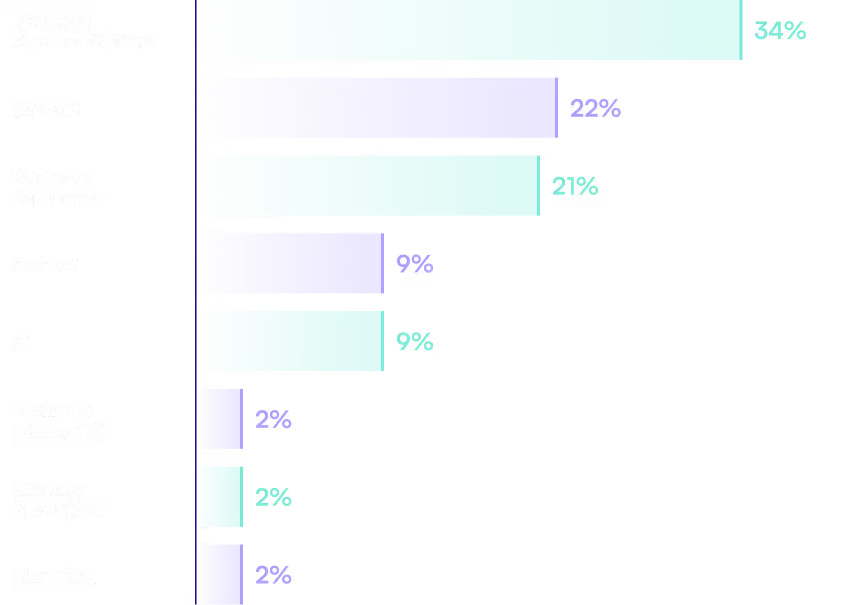
Who Owns Self-Service Strategy?
Graph 10: Department That Owns Self-Service Strategy
Who Owns Self-Service Content?
Graph 11: Department That Owns Self-Service Content

Technical Communications Leadership
One of the most striking findings in 2025 is the dominant role of Technical Communications in both strategy and content ownership. This represents a shift from last year, where Customer Experience led strategy ownership.
Why the change? Organizations are recognizing that effective self-service requires:
Why the change? Organizations are recognizing that effective self-service requires:
- Structured content expertise that Technical Communications teams possess
- Information architecture that scales across products and use cases
- Content operations that ensure consistency and accuracy
- Cross-functional translation of technical concepts into user-friendly language
However, this doesn't mean self-service is solely a Technical Communications responsibility. Success still requires deep collaboration across departments.
The Collaboration Imperative
The survey revealed that multiple departments remain heavily involved in self-service initiatives, including Customer Experience, Product, Engineering, IT, and Marketing. This cross-functional engagement is necessary because:
- Product knows what features do and how they work
- Engineering understands technical limitations and possibilities
- Customer Experience knows what customers struggle with
- Marketing understands positioning and messaging
- IT manages integrations and infrastructure
Organizations that succeed in 2025 have broken down silos and established regular touchpoints between these teams to keep self-service content aligned, accurate, and useful.
Graph 12: Cross-functional Engagement

CHAPTER four
Technology and Tools
The Delivery Experience
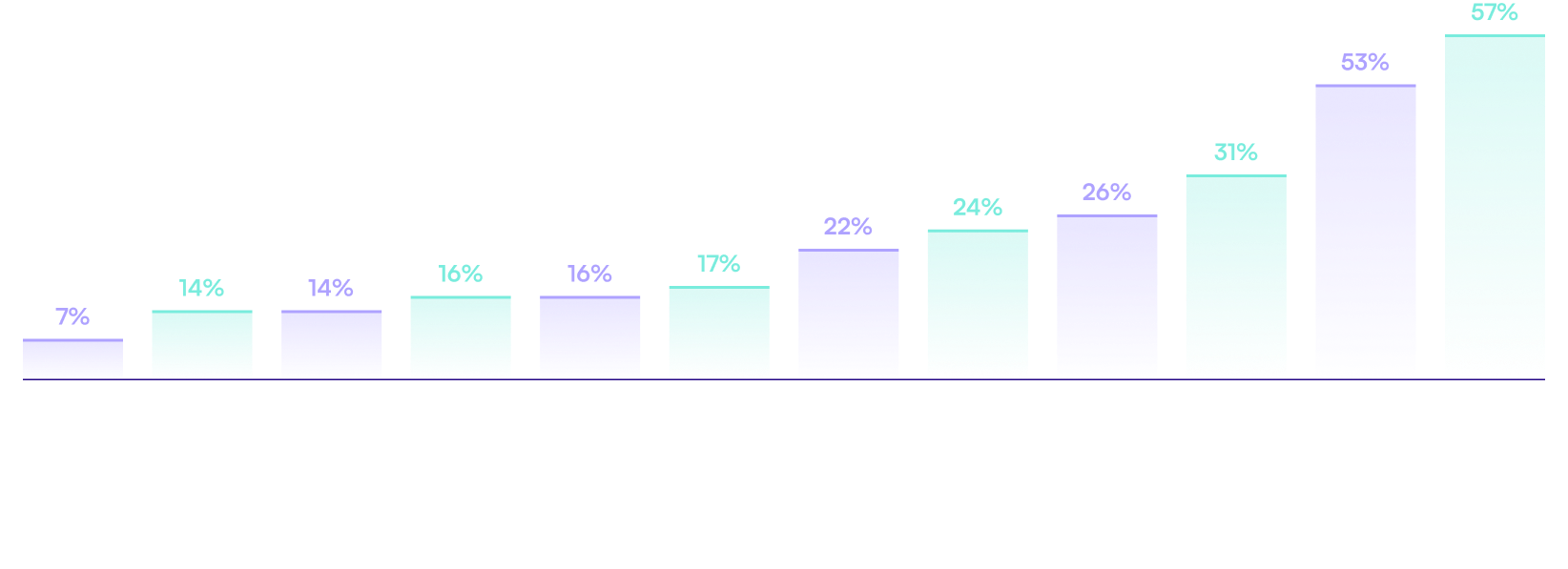
Top platforms for customer-facing self-service:
- Knowledge base/FAQ platforms: 57%
- Customer portals: 53%
- Chatbots/AI assistants: 31%
- Content Management Systems: 26%
The prevalence of multiple platforms (respondents could select more than one) reveals that modern self-service strategies deploy across multiple touchpoints. Customers expect to find answers wherever they're working—whether that's a dedicated help center, within the product interface, or through conversational AI.
.png)
Graph 13: Top platforms for customer-facing self-service
The Content Creation Challenge
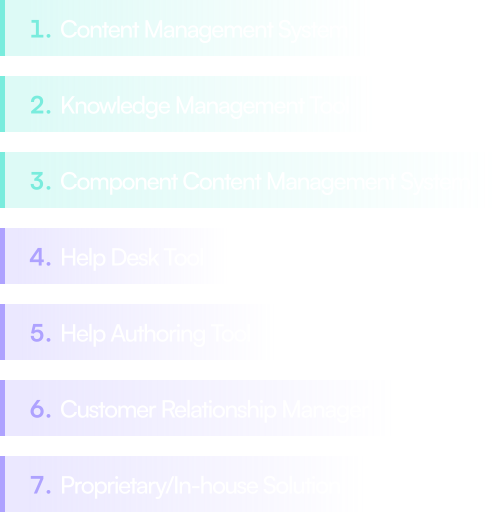
Tools used for creating and managing self-service content:
- Content Management System: 41%
- Knowledge Management Tool: 38%
- Component Content Management System: 34%
- Help Authoring Tool: 24%
The Fragmentation Reality:
Organizations continue to use multiple content creation tools simultaneously. While this reflects the reality of complex technology stacks, it creates several challenges:
- Inconsistent content quality and formatting across platforms
- Difficulty maintaining version control and single-source truth
- Inefficient review and approval workflows that slow publication
- Increased risk of outdated information across disparate systems
- Higher training and maintenance costs for content teams
Graph 14: Tools used for creating and managing self-service content:
Ranked in order of most utilized
Unifying Without Consolidating
The organizations showing the most success are those investing in unified content strategies, even if they can't immediately consolidate tools. This means establishing:
- Content standards and style guides that apply across all platforms
- Centralized governance with clear ownership and accountability for each content domain
- Structured content models that enable reuse and consistency regardless of authoring tool
- Shared workflows and review processes that create checkpoints before publication
- Regular content audits to identify and eliminate duplication or contradictions
- API integrations between systems to enable single-source publishing where possible
AI-Driven Features Gain Traction
When asked about user-facing AI support features, organizations reported varying levels of implementation:
- AI-driven suggestions and predictive recommendations: Most organizations report limited support (17 say "not supported at all," while only 6 report "very supported")
- Comprehensive search functionality: Better supported, with 31 organizations reporting moderate to very good support
- Analytics and reporting dashboards: 26 organizations report moderate to very good support
While AI is a top priority, many organizations are still building the foundational features required to support advanced AI capabilities.
CHAPTER FIVE
Measuring What Matters
Key Success Metrics
How organizations measure self-service success in 2025:
- Ticket deflection rate: 20%
- Customer satisfaction (CSAT): 15%
- Knowledge base/content views: 15%
- Time to resolution: 4%
- Search success rates: 5%
- Net Promoter Score (NPS): 5%
Graph 15: Primary metric organizations use to measure the success of self-service solution

The Shift Toward Balanced Scorecards
While operational metrics like ticket deflection rate remain the most common measurement, the diversity of metrics being tracked signals organizational maturity. The most sophisticated organizations track:
- Efficiency metrics (deflection rate, time to resolution)
- Quality metrics (CSAT, NPS)
- Usage metrics (content views, search success)
- Business metrics (customer retention, support cost per customer)
This balanced approach ensures that self-service doesn't just reduce support volume—it actually improves customer outcomes.
The Measurement Challenge
While self-service is often associated with post-sales support, this survey revealed a surprising finding: 20% of respondents identified prospective buyers as the primary audience for their self-service platforms. This is surprising because self-service is rarely considered an instrument in a pre-sales motion, yet these prospective buyers are present nevertheless.This insight calls attention to a critical opportunity for organizations to leverage self-service as a powerful sales enablement tool.

CHAPTER six
AI Takes Center Stage
AI Adoption Accelerates
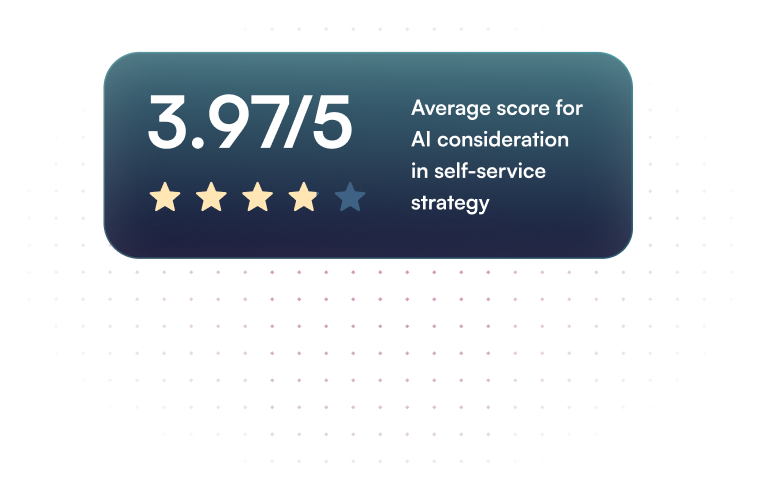
When asked about AI consideration for self-service strategy, organizations rated it 3.97 out of 5 on average, with 19 organizations calling it a "top priority" and 22 rating it a 4 out of 5. Only 4 organizations reported little to no consideration of AI.
This represents a dramatic shift from 2024, when 83% identified AI as "the next big trend." In 2025, AI has moved from aspiration to active implementation.
This represents a dramatic shift from 2024, when 83% identified AI as "the next big trend." In 2025, AI has moved from aspiration to active implementation.
What Organizations Are Implementing
While detailed AI implementation data is still emerging, the survey suggests organizations are focusing on:
- Enhanced search with natural language processing
- Chatbots and virtual assistants for initial triage
- Content recommendations based on user behavior
- Automated content updates triggered by product changes
Critical AI Implementation Success Factors
Organizations that have successfully implemented AI-enabled self-service solutions identified the most critical factors:
- High-quality, accessible content: 25%
- Strong cross-functional collaboration: 25%
- Clear alignment with organizational goals: 18%
Graph 16: Most critical key factors to the success of self-service implementation
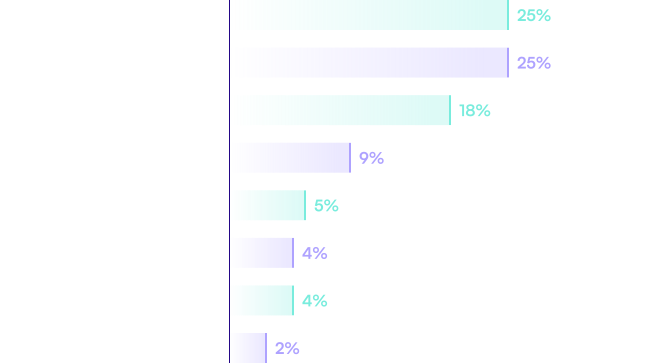
Key Insight: Notice that technology selection ranked far below content quality and collaboration. The tools matter, but what you do with them matters more. Organizations that invested in AI without first establishing strong content foundations and cross-team processes report limited success.

CHAPTER seven
Challenges and the Path Forward
Top Implementation Challenges
For organizations planning to implement self-service:
- Limited internal resources or bandwidth: 41%
- Uncertainty about the best solution: 14%
- Lack of budget: 9%
- Integration challenges with existing systems: 9%
Graph 17: Top Implementation Challenges

The Resource Reality
The data reveals a critical insight: budget isn't the primary barrier to self-service adoption. Only 9% cite lack of funding as the main challenge, while 41% point to limited internal resources and bandwidth.
This distinction matters. It suggests organizations see the value and can find the budget, but they struggle with:
This distinction matters. It suggests organizations see the value and can find the budget, but they struggle with:
- Competing priorities that pull teams in multiple directions
- Expertise gaps in content strategy and information architecture
- Change management challenges in shifting from human-led to self-service support
- Operational complexity of maintaining high-quality content at scale
Organizations succeeding despite these constraints have:
- Secured dedicated headcount for self-service initiatives
- Partnered with external experts to accelerate implementation
- Automated content workflows to reduce maintenance burden
- Built executive sponsorship to protect self-service teams from competing priorities


CONLUSION
The Inflection Point
The 2025 data reveals self-service at an inflection point. What was once emerging is now essential. What was once experimental is now expected. With 58% of organizations already implementing self-service solutions and another 18% planning to do so, we're witnessing the final stage of self-service's transformation from competitive advantage to competitive requirement.
Key findings
- Self-service is the preferred first channel for 35% of customers, leading all other support options—a clear signal that customer behavior has shifted permanently toward on-demand, independent problem-solving.
- Technical Communications has emerged as the strategic leader, owning both strategy (34%) and content (55%) in many organizations. This shift recognizes that effective self-service requires structured content expertise, information architecture, and content operations at scale.
- Resource constraints, not budget limitations, present the primary barrier to implementation (41% vs. 9%), revealing that self-service adoption requires dedicated teams, protected priorities, and executive sponsorship more than capital investment.
- Success depends on fundamentals, not technology alone. Organizations cite high-quality content (25%) and cross-functional collaboration (25%) as more critical to success than tool selection, proving that how you execute matters more than what you buy.


The Path Forward
For organizations already implementing self-service, 2025 is a year of optimization and AI experimentation. Focus on content quality, measurement sophistication, and operational excellence. Test AI capabilities carefully, ensuring they enhance rather than complicate the customer experience.
For organizations planning implementation, the window is closing. With three-quarters of organizations already implementing or planning self-service, delaying puts you at competitive disadvantage. Start with strong content foundations and clear governance—the technology will follow.
For organizations planning implementation, the window is closing. With three-quarters of organizations already implementing or planning self-service, delaying puts you at competitive disadvantage. Start with strong content foundations and clear governance—the technology will follow.
The Bottom Line
Self-service in 2025 is no longer about whether to implement, but how well you execute. Customer expectations have shifted irreversibly toward instant, accurate, on-demand support. Organizations that recognize self-service as a strategic imperative—investing in the people, processes, and platforms required for excellence—will thrive. Those that treat it as a tactical support channel will struggle to retain customers and compete effectively.
The future belongs to organizations that empower customers to succeed independently. The data is clear: that future is now.
The future belongs to organizations that empower customers to succeed independently. The data is clear: that future is now.

State of Customer
Self Service Report 2025
Self Service Report 2025