

.avif)
A product label might say it's compliant, but that doesn't always make it true. The same goes for your documentation. Creating truly ANSI compliant hazard statements requires more than just the right colors and signal words. It demands a real understanding of the standards to ensure every detail is correct. So, how can you be sure your warnings are right? It starts with understanding the purpose of ANSI standards and the structural rules for communicating risk. We'll cover the fundamentals of ANSI compliance and show you how to build hazard statements with confidence.
Many highly-regulated industries use Heretto to create manuals and documents for their products. One of the benefits of using Heretto is the ability to control the authoring and review process to make it compliant with certain safety regulations.
One of those safety standards is ANSI Hazard Statements.
What is ANSI?
At first glance, the world of standards and regulations can feel like a bowl of alphabet soup. But understanding the key players is essential, especially when you’re creating safety-critical documentation. The American National Standards Institute, or ANSI, is a name you’ll see often. It’s a private, non-profit organization that administers and coordinates the U.S. voluntary standards and conformity assessment system. Think of it less as a rule-maker and more as a facilitator, bringing together industry experts to agree on best practices for everything from hard hats to hazard statements in technical manuals.
A Coordinator, Not a Creator
One of the biggest misconceptions about ANSI is that it writes the standards itself. In reality, ANSI doesn’t develop standards. Instead, it accredits Standards Developing Organizations (SDOs) that follow its established procedures for openness, balance, and consensus. This process ensures that a diverse range of voices—from manufacturers and consumers to technical experts and government agencies—contributes to the final standard. The result is a set of guidelines that reflects a broad agreement on best practices, promoting both safety and innovation without being created in a vacuum by a single entity.
Voluntary Standards vs. Mandatory Regulations
It’s crucial to remember that ANSI standards are voluntary. No one is legally required to follow them unless they are incorporated into a contract or referenced by a government agency. However, "voluntary" doesn't mean "optional" in practice. Adhering to these standards is a powerful way to demonstrate a commitment to quality and safety. Strong content governance often involves aligning documentation with these best practices, as they frequently form the basis for industry expectations and can help protect your organization by showing due diligence in your processes and content operations.
ANSI's Role in Global Standards
ANSI’s influence isn’t limited to the United States. It serves as the official U.S. representative to the International Organization for Standardization (ISO) and the International Electrotechnical Commission (IEC). By participating in these global bodies, ANSI helps ensure that U.S. interests are represented in the development of international standards. This alignment makes it easier for American companies to compete in the global marketplace, as their products and documentation can meet internationally recognized benchmarks for quality and safety, simplifying processes like translation management and global distribution.
ANSI vs. OSHA: What's the Difference?
It’s easy to confuse ANSI with the Occupational Safety and Health Administration (OSHA), but their roles are fundamentally different. The simplest way to think about it is that OSHA sets the legal minimum, while ANSI often represents a higher standard of best practices. OSHA is a government agency that creates and enforces mandatory workplace safety regulations. If you don't comply with OSHA standards, you can face legal penalties. ANSI, on the other hand, develops voluntary consensus standards that organizations choose to adopt to improve their safety programs and product quality.
While ANSI standards are voluntary, OSHA frequently incorporates them into its own regulations by reference. When this happens, that specific ANSI standard effectively becomes law. For technical communicators, this means you must pay close attention to which standards are simply guidelines and which have been adopted as legal requirements. Following ANSI standards is a proactive way to go beyond the bare minimum, creating a safer environment and clearer instructions. Managing these different layers of compliance is where a dedicated Component Content Management System (CCMS) becomes invaluable, helping you ensure every piece of content meets the right requirements.
Why Does ANSI Compliance Matter?
The American National Standards Institute (ANSI) developed a standard to ensure communications about hazardous situations can be unified and cohesive. This is to help individuals working with potentially hazardous materials and situations quickly and easily understand information.
Manufacturers in the U.S.A. must ensure that all materials and manuals are Occupational Safety and Health Administration (OSHA) and ANSI-compliant, or they could face repercussions.
There are four types of Hazard Statements:
- Danger
- Warning
- Caution
- Notice
Each one has predetermined use cases and requirements. All four types of statements can be found in Heretto.
How to Verify True ANSI Compliance
Ensuring your products and documentation meet ANSI standards is critical, but how can you be certain a "compliant" label tells the whole story? True verification requires a bit more diligence than simply reading the packaging. It involves looking for specific documentation that proves a manufacturer has followed the correct testing procedures. This process is essential for maintaining safety and ensuring that the information you provide in your technical content is backed by legitimate, verifiable data.
Look Beyond the Label
Just because a product's label or website claims it is "ANSI compliant" doesn't automatically make it so. There isn't a regulatory body that actively polices these claims, which means the responsibility for verification falls on the consumer or organization. This is a crucial step in risk management. Relying on a label alone can expose users to unsafe conditions and your organization to liability. You have to dig a little deeper to confirm that the product has actually undergone and passed the necessary testing to meet the rigorous requirements of the relevant ANSI standard.
The Role of a Declaration of Conformity (DOC)
If you can't always trust the label, what should you look for? The key is a document called a Declaration of Conformity (DOC). This is the only definitive way to know if a product truly meets ANSI standards. The DOC is a formal, legal document issued by the manufacturer that explicitly states the product has been tested and conforms to a specific standard. You should be able to request this document from the manufacturer. Managing these declarations alongside your product manuals is a core part of a complete content governance strategy, ensuring all compliance information is centralized and accessible.
Why Third-Party Accreditation Matters
Even with a DOC in hand, there's one more critical detail to check for: an accreditation mark from a recognized third-party testing agency. This mark is the ultimate proof of legitimacy. It certifies that the product was tested in an accredited laboratory that follows strict protocols. The presence of this mark on the DOC confirms that the results are objective and reliable. It separates manufacturers who are genuinely committed to safety and quality from those who might be cutting corners. This level of rigor is what ensures the integrity of the compliance claim.
When to Use a Note vs. a Hazard Statement
When creating a notice in Heretto, you have the option to use Notes or Hazard Statements elements. When deciding whether to use Notes versus Hazard Statements for warnings in your document, it’s important to understand the differences between the two. While they have similar functions, there are some key distinctions.
Notes are used to call attention to a piece of information in a document. Notes are not compliant with ANSI. Both can be included in any topic type and you can change the type attribute.
Hazard Statements are used to inform readers about potential hazards, consequences, avoidance, and strategies. They’re more specialized and are a more complex structure than a Note. Authors can add icons and style them in a specific way.
How to Write ANSI-Compliant Hazard Statements
Hazard Statements in Heretto have the full potential to be ANSI compliant. In fact, this is one of the use cases where Heretto really shines.
DITA Hazard Statements are based on ANSI regulations, however, whether or not they are compliant depends on how the author formats the output regarding colors, fonts, icons, and messages.
Here’s an example of how to create a typical Hazard Statement:
<hazardstatement type="danger">
<messagepanel>
<typeofhazard>Type of Hazard element - description of the type of hazard.</typeofhazard>
<consequence>Consequences</consequence>
<howtoavoid>How to avoid element - how the user can avoid it.</howtoavoid>
</messagepanel>
<hazardsymbol href="Bio-hazard-symbol.jpg" width="50px"/>
</hazardstatement>
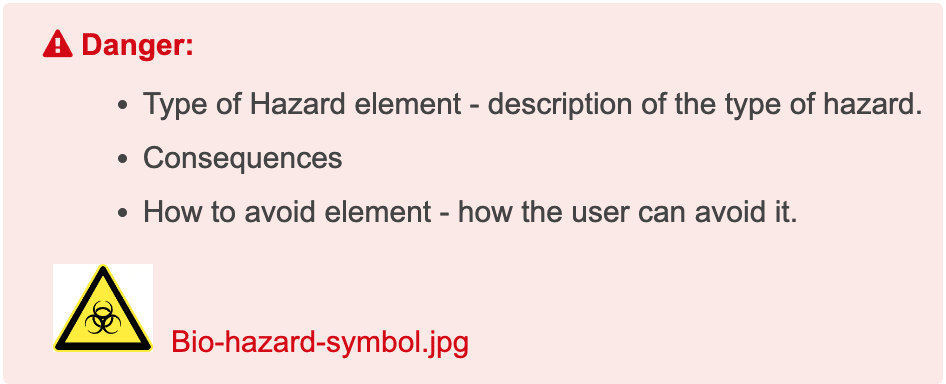
Heretto makes creating these elements easy since authors have complete control over the styling of the elements.
Beyond Hazard Statements: Other Common ANSI Standards
While technical writers are most familiar with ANSI standards for hazard communication, the institute's influence is much broader. ANSI coordinates the development of thousands of standards across countless industries, from the safety glasses on a factory floor to the programming language used in a database. Understanding this wider context helps appreciate the foundational role standards play in creating safe, reliable, and consistent products and information—goals that are central to effective technical documentation and content operations.
Workplace Safety and Equipment
Beyond communication, ANSI helps establish guidelines to ensure physical products and equipment are safe and reliable. Think of it this way: the Occupational Safety and Health Administration (OSHA) sets the minimum safety rules required by law. ANSI standards, however, often provide higher safety practices and benchmarks for product quality. When you document procedures for a piece of industrial machinery or specify the type of required personal protective equipment (PPE), you're often working with products designed and tested against these rigorous ANSI standards. This ensures that the equipment not only meets legal requirements but also adheres to a higher consensus-based standard for safety and performance.
Digital Standards for Data and Databases
ANSI's role also extends into the digital realm, particularly with data and databases. For instance, there is an ANSI standard for the SQL (Structured Query Language) used to communicate with databases. Databases that adhere to this standard ensure that SQL commands work consistently, regardless of the specific database software being used. This compliance is crucial for interoperability and data integrity, preventing inconsistencies that can arise when moving data between different systems. For technical content teams, this principle mirrors the value of structured authoring: using a standard like DITA ensures that content is consistent, predictable, and portable across different publishing outputs and platforms.
Where to Go From Here
If you’re interested in learning more about creating ANSI-compliant Hazard Statements, check out the ANSI website. If you want to learn more about creating OSHA-compliant documents, check out the OSHA website.
There you can find more information about the correct way to style things like:
- Color standards
- Safety symbols
- Safety signs
- Safety charts
When you use this information and the Heretto formatting, you’ll be able to create OSHA and ANSI-compliant Hazard Statements easily.
Content is king. But if you have amazing content that’s not easily accessible, you’re missing out on a huge opportunity.
Frequently Asked Questions
Is following ANSI standards a legal requirement? Not directly. ANSI standards are voluntary guidelines that represent industry best practices. However, government agencies like OSHA often incorporate specific ANSI standards into their mandatory regulations. When that happens, compliance with that particular standard becomes a legal requirement. It's best to treat them as essential for demonstrating due diligence and a commitment to safety, rather than as optional suggestions.
Why can't I just use a "Note" element for a warning? While a "Note" can draw attention to information, it lacks the specific structure required for communicating risk effectively. A formal Hazard Statement is designed with distinct parts—like the type of hazard, potential consequences, and how to avoid it—that align with ANSI's framework for safety communication. Using the correct Hazard Statement element ensures your warnings are clear, consistent, and structured for compliance.
Does using a platform like Heretto automatically make my hazard statements compliant? Heretto provides the framework and control needed to create fully compliant hazard statements, but it doesn't happen automatically. The platform gives you the DITA elements and styling capabilities to meet the standards, but you, the author, are responsible for inputting the correct information and applying the right formatting for colors, icons, and messages according to the official ANSI guidelines.
What's the single most important document for verifying a product's ANSI compliance? The most definitive proof is the Declaration of Conformity, or DOC. This is a formal document from the manufacturer stating that the product has been tested and conforms to a specific ANSI standard. For the highest level of assurance, this document should also include an accreditation mark from a third-party testing agency, which confirms the testing was objective and followed proper protocols.
Besides hazard statements, what's another common ANSI standard that affects technical content? ANSI's influence extends to the digital tools we use every day. For example, ANSI establishes the standard for SQL, the language used to interact with databases. This ensures that commands work consistently across different database systems. This principle of standardization for interoperability is the same reason technical content teams use standards like DITA—to ensure content is consistent and portable.
Key Takeaways
- Treat ANSI as the goal and OSHA as the baseline: OSHA regulations are the legal floor for safety compliance, while ANSI standards represent industry-recognized best practices. Adhering to them demonstrates a higher commitment to safety and is a key part of risk management.
- Look for proof, not just a promise: An "ANSI compliant" label on its own is not enough. True verification requires obtaining a Declaration of Conformity (DOC) from the manufacturer that includes an accreditation mark from a third-party testing agency.
- Remember that structure is only half the battle: Using the correct DITA elements for hazard statements is the right start, but true compliance is your responsibility. You must ensure the final output is styled with the specific colors, symbols, and messages required by the standard.


