
.png)
.avif)
We've all been there: typing a question into a search bar, only to get results that completely miss the point. The problem isn't your question; it's that most search tools need exact keywords to work. They can't read between the lines. This is where semantic search completely changes the game. A semantic based search engine doesn't just match words; it understands meaning and intent. It connects what you're asking in your own words to the precise answer you need, making search feel less like a guessing game and more like a conversation.
That's the power of semantic search. It's not just about keywords anymore; it's about understanding the intent and context behind your search.
In this article, we'll dive into the world of semantic search and discover how structured content is the key to unlocking its full potential. Get ready to see how search engines have evolved from simple keyword matches to intelligent interpreters of human language.
Quick Takeaways
- Search engines have evolved from keyword-based to understanding the intent and context behind searches, making results more accurate and relevant.
- Structured content organizes and categorizes digital information, making it easily accessible and understandable to both humans and search engines.
- Structured content enhances semantic search by providing clear, organized data, improving search engine understanding, and resulting in better rankings and visibility.
- Implementing semantic search, particularly with AI integration, requires balancing AI efficiency with human creativity, focusing on user intent, and navigating challenges like misinformation and regulatory complexities.
From Keywords to Concepts: The Rise of Semantic Search
Search engines have come a long way since their inception. In the early days, they relied heavily on keywords to deliver search results. If you typed 'apple,' you'd get results about the fruit, the tech company, or anything with the word 'apple' in it. But now, things are different.
As of July 2023, Google, the market leader in search engines, holds around 83.49% of the global desktop search market.
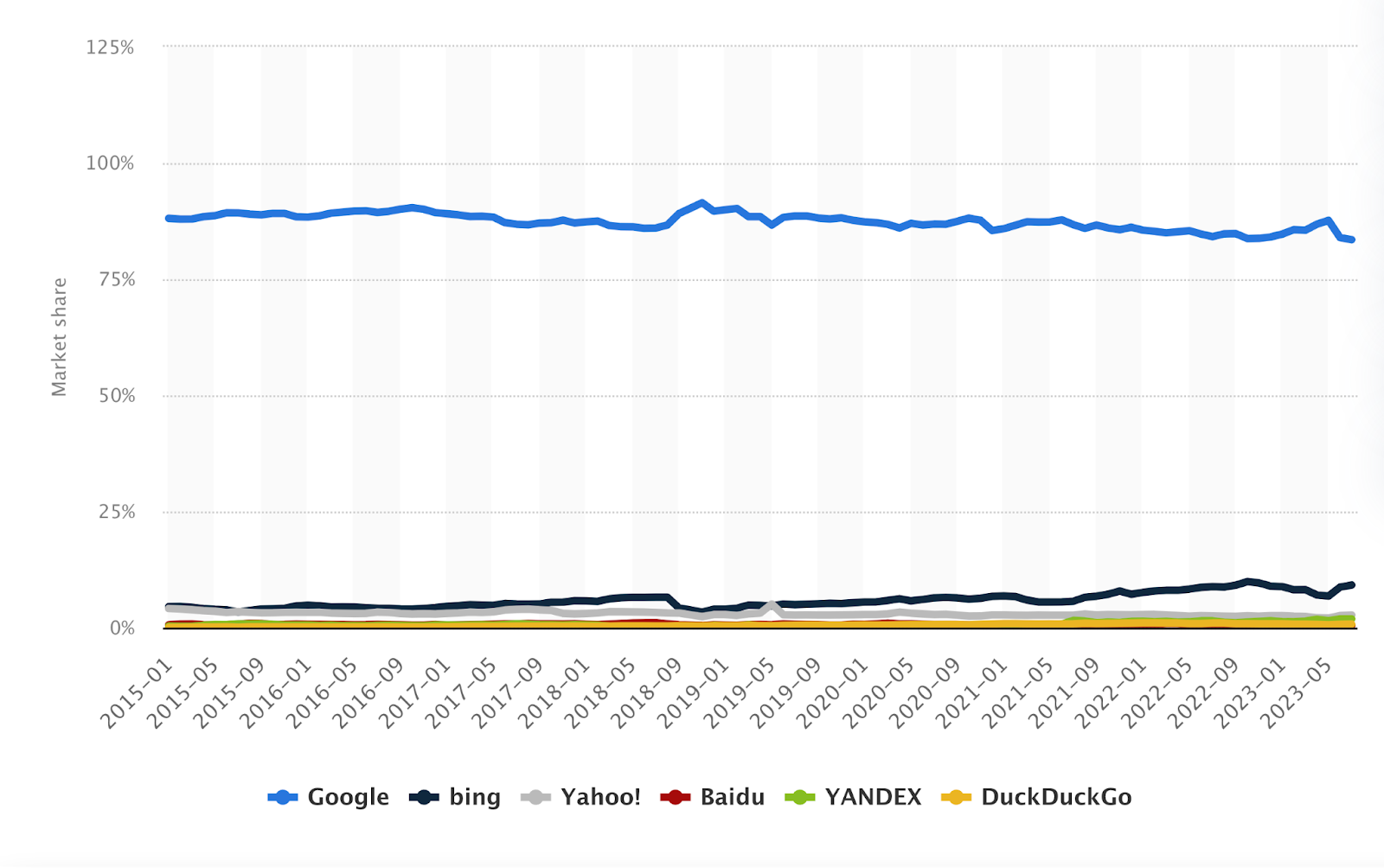
This dominance is not just about size; it's about how Google and others like Bing have evolved.
Today, these search engines use semantic search. This means they don't just look at the keywords you type. Instead, they try to understand the intent and context behind your search. For instance, if you search for 'apple pie recipe,' the engine understands you're looking for cooking instructions, not just any page that contains those words.
This shift to semantics has transformed how we find information online. It's more accurate, more relevant, and incredibly intuitive.
But how did we get here? It's all thanks to the development of complex algorithms and, importantly, the role of structured content, which we'll explore next.
What is Semantic Search?
At its core, semantic search is a process that aims to understand the meaning behind your words, not just the words themselves. It moves beyond the old method of matching exact keywords to decipher the intent and contextual meaning of a search query. Think of it as the difference between a librarian who only finds books with your exact search term in the title and one who understands what you’re trying to learn and suggests the best resources, regardless of their titles. This intelligent approach allows search engines to deliver more accurate, relevant, and comprehensive results by grasping the relationships between words and concepts.
This shift is powered by complex technologies like artificial intelligence and machine learning, which analyze language in a way that mirrors human understanding. Instead of seeing a query as a simple string of text, a semantic search engine considers synonyms, the context of the search, and even the user's search history to figure out what they truly want to find. For technical documentation teams, this means that users can find the right answers even if they don't know the precise terminology, leading to a much more effective self-service support experience.
Comparison with Other Search Types
To really get what makes semantic search different, it helps to compare it to other search methods. The most common type we're all familiar with is lexical search, which has been the standard for decades. But as technology has advanced, new methods like vector search have emerged as the engine driving modern semantic capabilities. Understanding these distinctions clarifies why semantic search is such a significant step forward for finding information accurately and efficiently.
Lexical and Contextual Search
Lexical search, often called keyword search, operates on a simple principle: it looks for exact word matches or very close synonyms. If you search for "configure network adapter," it will scan its index for documents containing those specific words. While straightforward, this method can be rigid. It struggles with ambiguity, synonyms, and user intent. Contextual search, which is the essence of semantic search, goes deeper. It focuses on the meaning behind the words. It understands that "set up internet connection" is conceptually the same as "configure network adapter," delivering relevant results for both queries because it grasps the user's underlying goal.
Vector Search vs. Semantic Search
It's common to hear vector search and semantic search used interchangeably, but they aren't quite the same thing. Semantic search is the overall goal: to understand the meaning of a query. Vector search is one of the primary methods used to achieve that goal. It works by converting words, phrases, and entire documents into numerical representations called "vector embeddings." The search engine then compares the vector of your query to the vectors of the content in its database. Results are ranked based on how "close" their vectors are, meaning they are the most similar in meaning, not just in wording.
How Semantic Search Works
The magic of semantic search isn't really magic at all; it's a sophisticated, multi-step process designed to interpret language like a human would. It begins the moment you type your query and hit enter, kicking off a chain of events that involves deconstructing your language, translating it into a format a computer can understand, and then scouring a vast database for conceptually related information. This process ensures that the results you get are not just a list of keyword matches but a curated selection of content that genuinely addresses the intent behind your search. Let's break down the key stages of this process.
Query and Content Analysis
The first step is analysis. When you enter a search query, the system doesn't just see a list of words; it sees a question or a command that needs to be understood. Using Natural Language Processing (NLP), the search engine breaks down your search terms to figure out what you really want. It identifies the key entities, the relationships between them, and the overall intent. For example, in the query "how to reset admin password on Model X," it recognizes "reset" as the action, "admin password" as the object, and "Model X" as the specific product, allowing it to look for precise instructional content.
Vector Embeddings: Translating Words into Math
Once the search engine understands your query, it needs to find content that matches its meaning. This is where vector embeddings come in. This process uses advanced machine learning models to convert your query—and all the content in the database—into numerical codes, or vectors. Each vector represents a specific point in a high-dimensional space, where concepts with similar meanings are located close to one another. This mathematical representation allows the computer to "understand" the relationships between words and ideas. For instance, the vectors for "troubleshoot" and "fix" would be very close together, reflecting their similar meanings.
Vector Search and Similarity Comparison
With your query translated into a vector, the final step is to find the best matches. The system performs a vector search, comparing your query's vector to the millions or billions of vectors representing the content it has indexed. It calculates the "distance" or "similarity" between your vector and all the others. The documents whose vectors are closest to your query's vector are deemed the most relevant. This is why semantic search can return a perfect tutorial on fixing a bug even if your search query used completely different words than the article itself.
Key Components and Technologies
Semantic search is not a single technology but an ecosystem of interconnected components working together. At its heart are powerful AI models that have been trained on massive datasets to understand the nuances of human language. These models are supported by specialized databases built for speed and efficiency, along with structured data frameworks that provide real-world context. For organizations looking to implement this technology, understanding these core components is essential for building a search experience that is both intelligent and reliable. These technologies are what transform a simple search bar into a powerful tool for knowledge discovery.
AI and Machine Learning Models
Artificial intelligence and machine learning are the brains of the operation. Specifically, Natural Language Processing (NLP) models help the search engine comprehend human language in all its complexity, from grammar and syntax to slang and sentiment. These models are trained to find patterns and connections in data, which is how they learn to generate the meaningful vector embeddings that are crucial for the search process. Companies like OpenAI and Google have developed large language models (LLMs) that excel at this, making them a foundational piece of modern semantic search technology.
Vector Databases
Traditional databases are great for storing structured data like customer records or inventory, but they aren't built to handle the unique demands of vector embeddings. Vector databases are specialized systems designed to store and efficiently search through enormous amounts of high-dimensional vector data. They use sophisticated indexing algorithms to perform similarity searches at incredible speeds, making it possible to find the closest vector matches among billions of options in milliseconds. This specialized infrastructure is what makes real-time semantic search feasible at scale.
Knowledge Graphs and Semantic Ontologies
While vector embeddings capture conceptual meaning, knowledge graphs provide factual, real-world context. A knowledge graph, like the one Google uses, is a network that connects different pieces of information and understands how they relate to each other. For example, it knows that a specific product model is manufactured by a certain company and has a particular set of features. This structured data, often built using semantic ontologies, helps the search engine resolve ambiguity and provide more accurate, fact-based answers, making it a powerful complement to the conceptual understanding provided by AI models.
The Benefits of Semantic Search
Adopting semantic search isn't just about keeping up with the latest technology; it's about fundamentally improving how users find information. The benefits extend far beyond simply getting better search results. For businesses, it translates into a more effective and satisfying customer experience, which can have a direct impact on loyalty and retention. By understanding what users truly mean, semantic search removes friction from the information-seeking process, empowering users to solve their own problems quickly and efficiently. This creates a win-win scenario where customers feel supported and businesses reduce the burden on their support teams.
Handles Ambiguity and Synonyms
One of the biggest weaknesses of traditional keyword search is its inability to handle the richness of human language. People use different words to describe the same thing—"laptop," "notebook," and "portable computer" all refer to the same device. Semantic search excels at this. It understands that these terms are synonymous and will return the same relevant results for all of them. This flexibility allows users to be more natural with their queries, leading to better answers without needing to guess the exact terminology used in the documentation. This is especially critical in technical fields where jargon can vary.
Supports Conversational Queries
With the rise of voice assistants and chatbots, people are increasingly searching with full, conversational sentences. Instead of typing "Model X password reset," a user might ask, "How do I change the password on my Model X?" A keyword-based system would struggle with the extra words, but a semantic search engine is built for it. It can parse the natural language, identify the core intent, and deliver the correct information. This ability to handle conversational queries makes searching feel more intuitive and accessible, almost like talking to a helpful expert.
Improves the Customer Experience
Ultimately, the greatest benefit of semantic search is a superior customer experience. When customers can find answers to their questions quickly and effortlessly, their satisfaction and confidence in your product grow. By understanding what customers really want, businesses can provide better self-service support, which in turn reduces frustration and lowers the number of support tickets. This transforms your technical documentation from a static library of information into a dynamic, responsive resource that actively helps customers succeed. A powerful search function is a cornerstone of effective content management and delivery.
Use Cases and Examples
The applications of semantic search are broad and impactful, touching nearly every industry where finding information quickly is critical. From online shopping to internal corporate knowledge bases, its ability to understand user intent is transforming how we interact with digital content. For technical documentation teams, these use cases offer a clear picture of how semantic search can be applied to solve common challenges, such as helping users find specific instructions within a massive help center or enabling employees to locate internal procedural documents. The technology is already in wide use, proving its value in real-world scenarios every day.
E-commerce
In e-commerce, semantic search helps you find products more easily, even with vague or descriptive queries. If you search for "comfortable pants for working from home," a semantic search engine won't just look for products with those exact words in the description. Instead, it will understand the concept and show you results for joggers, lounge pants, and other items known for comfort and casual wear. This leads to a better shopping experience, higher conversion rates, and happier customers who can find what they're looking for without having to browse through countless irrelevant items.
Enterprise Search
Inside a large organization, finding the right document can be a major challenge. Enterprise search powered by semantic technology helps employees quickly locate information within the company's internal systems, such as intranets, shared drives, and documentation portals. An engineer could search for "best practices for API security" and instantly find relevant design documents, coding standards, and past project reports, even if they use slightly different terminology. This makes teams more productive by reducing the time wasted searching for information and ensuring everyone has access to the knowledge they need to do their jobs effectively.
Companies Using Semantic Search
Semantic search is not a futuristic concept; it's already a core part of the technology used by the world's biggest companies. Google has been a pioneer in this space for years, constantly refining its algorithms to better understand user intent. E-commerce giants like Amazon use it to power their product search and recommendations. Tech leaders such as Microsoft (with Bing) and IBM (with watsonx) have heavily invested in semantic capabilities. Even the AI companies at the forefront of the current revolution, like OpenAI and Anthropic, rely on these principles to power their conversational models.
What is Structured Content?
Let's break down what structured content really means. Imagine you're organizing a closet. Instead of throwing everything in haphazardly, you put shirts in one section, pants in another, and shoes on a rack.
This is what structured content does for digital information. It organizes and categorizes content so that it's easily accessible and understandable, not just by humans, but by search engines too.
Structured content is about planning, developing, and connecting content outside of an interface, making it ready for any interface. It's like breaking down information into its smallest, most meaningful components. Each piece of content, whether it's text, images, or videos, is tagged and categorized, making it easier for search engines to understand and retrieve.
The opposite of structured content is 'unstructured' content, which makes up more than 80% of digital data.

It's like the cluttered closet we mentioned earlier. Unstructured content is more challenging to find and analyze because it lacks a predefined organization or framework.
How Structured Content Powers Semantic Search
Structured content plays a pivotal role in the realm of semantic search. Semantic search is all about understanding the intent and context behind a user's query rather than just matching keywords. Structured content feeds into this by providing clear, organized data that search engines can easily interpret and use to deliver more accurate and relevant results.
Helping Search Engines Understand Your Content
- Tagging and Categorization: When content is structured, it's tagged and categorized in a way that makes sense not just to humans, but also to search engines.
- Clarifying Relationships: This structured data helps search engines understand the relationships between different pieces of content and the nuances in their meanings.
Delivering More Relevant Search Results
- Rich Snippets and Knowledge Graphs: The impact of structured content on semantic search is evident in the rise of rich snippets and knowledge graphs in search results.
- Improved Rankings and Visibility: Organizations that effectively use structured content often see better search engine rankings and improved visibility.
Ultimately, structured content is much more than just organizing information neatly; it's about presenting your content in a way that's inherently understandable to search engines and content platforms. This clarity and precision are crucial in the realm of semantic search, where understanding the relevance and context of content is paramount. Creating technical documentation with structured content makes it easier for search engines to understand the context of your documentation, and deliver more accurate results to users.
What to Consider When Implementing Semantic Search
Implementing semantic search, especially with the integration of AI, brings its own set of challenges and considerations. It's crucial to strike a balance between the efficiency of AI and the irreplaceable value of human creativity.
Shifting Focus from Keywords to User Intent
- Evolving SEO Strategies: The focus has shifted from keyword density to understanding user intent and context, demanding a more creative and relevant approach to SEO.
- Combining Empathy with Analytics: Successful semantic search implementation requires a mix of empathetic writing and data analytics, aiming to deliver content that's relevant and valuable.
Where AI Fits into Semantic Search
- Understanding Real Intent: AI technologies use natural language processing to grasp the true intent behind searches, moving beyond mere keyword matching.
- Personalization through AI: AI enhances search personalization by analyzing past user data, like search history and location, to predict future preferences.
Using AI as a Tool, Not a Replacement
- The Human Touch in AI: Despite AI's advancements, the nuanced understanding and narrative crafting by humans remain vital. This balance is where AI optimization (AIO) and frameworks like C.R.A.F.T come into play.
- Content Creation and AI: AI's role in content creation is growing, but it requires human intervention to refine and enhance AI-generated drafts, ensuring they maintain brand voice and language.
While AI significantly impacts semantic search, offering immense opportunities, it's crucial to navigate these challenges carefully. The synergy of AI and human expertise will be key in optimizing search and creating content that resonates with both search engines and users.
Limitations and Technical Requirements
While semantic search is a huge leap forward, it's not a magic wand. Adopting this technology means being aware of its practical limitations and technical demands. It requires more than just flipping a switch; it involves a deeper investment in both your technology and your content strategy to truly make it work for your users and your business.
Computational Complexity
Compared to a simple keyword search, semantic search is doing some heavy lifting behind the scenes. It requires significantly more computational power to analyze queries, understand context, and sift through content to find the most relevant answer. Think of it as the difference between looking up a word in a dictionary and having a conversation with a librarian who understands your question. This complexity demands a more robust infrastructure and advanced algorithms, which is why having a solid foundation for managing your structured content is so important. A well-organized content repository makes the job easier for these powerful search systems.
Struggles with Niche Jargon
Semantic search models learn from enormous amounts of data, but that data is often very general. As a result, these systems can struggle with highly technical or obscure jargon specific to your industry. If the model hasn't seen a term before or doesn't understand its specific context, it can deliver less accurate results. This is a critical challenge for technical documentation teams. The best way to combat this is by creating clean, consistent, and well-defined source material. Using a structured authoring approach like DITA XML helps enforce terminology standards, creating a reliable knowledge base that gives search algorithms a much better chance of understanding your specialized language.
Getting Started with Semantic Search
The evolution from keyword-based to semantic search engines, underscored by the pivotal role of structured content, signifies a major shift in digital content interaction. This transformation, further enhanced by AI integration, demands a nuanced balance between technological efficiency and human insight.
Embracing this change means ensuring content is relevant and resonant, blending data-driven precision with the human touch in our digital narratives.
Ready to embrace the future of semantic search and structured content? Heretto can help you dive into the world of structured content. Get started today by booking a demo or learn more about Heretto.
Frequently Asked Questions
What's the real difference between semantic search and the keyword search I'm used to? Think of it this way: keyword search is like a simple file lookup. It scans for the exact words you typed and shows you every document where they appear. Semantic search is more like asking a knowledgeable colleague for help. It listens to your question, understands the intent behind it, and finds the most relevant answer, even if the document uses completely different phrasing. It's the difference between matching words and understanding meaning.
Why is structured content so crucial for making semantic search work well? Semantic search needs clear context to do its job, and structured content provides that context. When you organize your information into logical, tagged components, you're essentially creating a detailed map for the search engine. This map explains what each piece of content is and how it relates to other information. This clarity allows the search technology to move beyond guesswork and deliver truly accurate results.
Does using semantic search mean I can stop worrying about specific keywords in my documentation? Not completely, but it does shift your focus. Instead of trying to predict and include every possible keyword a user might type, you can concentrate on writing clear, helpful content that directly answers a question or explains a process. Semantic search is smart enough to connect related concepts and synonyms. Your main goal should be creating high-quality, user-focused documentation; the technology will help connect users to it.
My company has a lot of very specific technical jargon. Can semantic search handle that? It can, but it performs best when it has clean, consistent information to learn from. General search models may not understand your niche terminology right away. This is where a structured authoring approach becomes so important. By consistently defining and using your specific terms within a structured system, you create a reliable knowledge base that effectively teaches the search engine your unique language, making it much smarter for your users.
How does implementing semantic search actually improve the customer experience? It directly reduces customer effort and frustration. When users can ask a question in their own words and get the right answer on the first try, they solve their problems faster and feel more confident using your product. They don't have to guess the "correct" technical term or sift through irrelevant search results. This leads to more successful self-service, which builds trust and lowers the burden on your human support teams.


